Curtain Lining: Types and Benefits for Light Control
Compare curtain lining types and their benefits for light control, insulation, fabric protection and a better curtain finish in different rooms.
Makaseb
November 18, 2026 at 6:53 pm AST
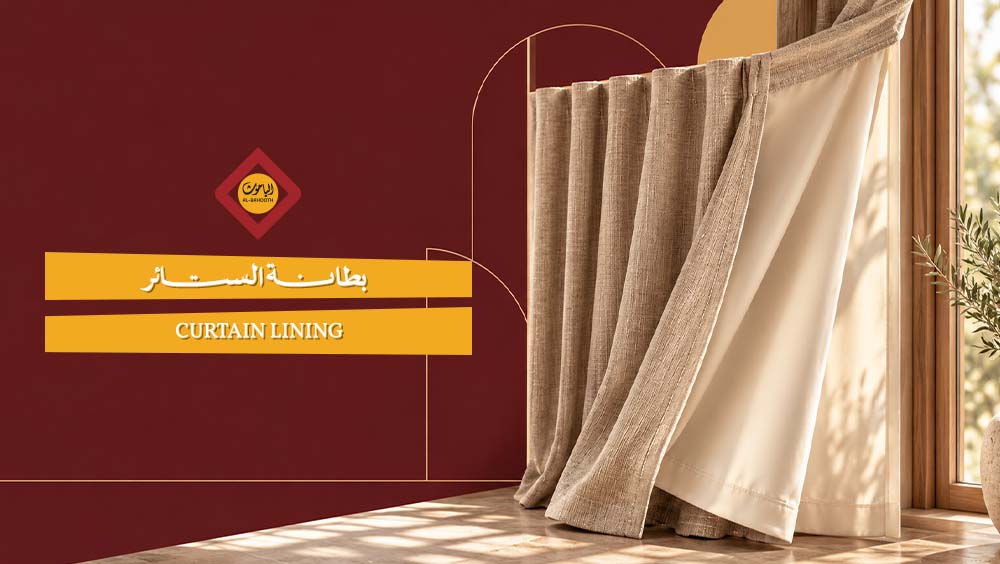
Curtain lining serves as a practical solution to a challenge faced by many homeowners in Saudi Arabia—a layer added behind the curtain fabric to enhance its drape, help protect the material, and boost indoor privacy. Depending on its type, this layer may reduce light penetration or heat transfer, though the final outcome is also influenced by curtain dimensions and installation methods within the space.
Many residents deal with intense sunlight near windows, a need for greater privacy and darkness in bedrooms, or a desire to preserve the curtain fabric's appearance from wear over time. Selecting the right curtain lining begins with identifying the required function for the space—whether full blackout, thermal insulation, or basic fabric protection—rather than relying on the type name alone without linking it to actual needs. Defining this function first helps in selecting a blackout lining or thermal lining suited to the room's nature and project requirements.
You can contact Bahooth Furniture Factory to discuss space needs and required specifications within custom furnishing and curtain tailoring solutions, taking into account the interior design and individual requirements of each project.
Function of Curtain Lining Behind the Main Fabric
Lining is a component added to a curtain rather than a standalone drapery; understanding its placement and role prevents confusing a supportive rear layer with a curtain inherently made from opaque fabric. Below is a clarification of this distinction in terms of placement and function.
1. Lining Placement and Relationship to Curtain Fabric
The lining is attached behind the front fabric of the curtain, adding structural support and relative weight that helps it fall evenly along the window. It also reduces the curtain fabric's direct exposure to sunlight depending on its attachment method and thickness, which positively reflects on the fabric's appearance and durability over repeated use.
2. Difference Between Lining and Full Blackout Curtains
There is a fundamental difference between a blackout lining added as a rear layer to curtain fabric, and a blackout curtain where light blockage is an inherent property of the fabric's weave or structure itself. Both options may serve the same purpose of reducing incoming light, yet they are distinct products in composition and installation, and one should not be used as a synonym for the other.
It is important to recognize that having a lightweight lining behind a curtain does not automatically darken a room completely. Furthermore, the label "blackout" alone is not enough to expect total darkness if gaps remain around the window frame or between the curtain and the wall, as light leakage through these openings remains possible regardless of the fabric or lining type used.
Types of Curtain Linings and Differences in Performance
Linings differ from one type to another in structure and function, with differences becoming evident when considering desired light levels inside the room, curtain appearance after installation, and window exposure conditions. Knowing these differences helps choose the appropriate type for each space.
1. Standard Lining for Fabric Support and Light Filtering
Standard lining is a relatively lightweight rear layer whose primary function is supporting the front curtain fabric and improving its overall appearance when hung. This lining filters a portion of incoming window light, though it does not necessarily provide high darkening levels.
- Function: Reinforcing the fabric and improving its drape without adding heavy weight.
- Light: Filtering a portion of illumination while retaining natural brightness inside the room.
- Common Use: Spaces that do not require full darkening, focusing instead on a neat, structured curtain look.
2. Medium-Weight Lining for Improved Drape
Sateen or medium-weight lining is offered in some products as a middle-ground option between lightweight lining and blackout lining. It helps filter light and enhances curtain fall and drape while retaining some natural daylight indoors. The label "sateen" should not be treated as a fixed darkening grade, as performance varies depending on weave structure and manufacturing.
3. Thermal Lining for Reducing Heat Transfer
Depending on their structure, coating, and installation method, some thermal linings can help reduce heat transfer from the window side, though some light may still pass through despite their presence. This performance relies on each product's specific manufacturing details rather than its name alone.
Thermal lining is not presented as a substitute for building or glass insulation, nor should it be assumed that every lining labeled "thermal" is simultaneously opaque. Reviewing actual product specifications is recommended before adopting this type as a sole thermal solution.
4. Blackout Lining for Controlling Room Lighting
Blackout lining is designed to significantly reduce light penetration compared to other types. In certain products, this lining relies on a specialized coating or multi-layer structure that aids in blocking illumination.
The actual post-installation darkening level cannot be deduced from the name "blackout lining" alone, as performance varies by manufacturing technique and layer count. Terms such as "1-Pass" and "3-Pass" in some products may refer to the number of coating layers rather than a fixed darkness result for every curtain; therefore, actual specifications should be reviewed alongside dimensions and mounting methods.
5. Interlining for Increasing Curtain Fullness
Interlining is used as an extra layer placed between the front fabric and the rear lining to increase the curtain's thickness and visual fullness. It remains an independent category of its own and is not another name for thermal or blackout lining, even though it can be combined with other types within a single design.
Benefits of Lining for Light, Privacy, and Curtain Appearance
The benefits of curtain lining tie into three interconnected daily needs: comfortable indoor lighting, sufficient exterior privacy, and a cohesive appearance for the curtain itself. The strength of each benefit varies from one product to another based on the lining type and primary fabric used.
1. Reducing Light and Glare by Lining Type
A lining's ability to control light scales according to its type. Standard lining filters a portion of incoming light without blocking it entirely, whereas medium-weight lining can reduce penetration further depending on the density of the paired main fabric. Blackout lining aims to block a much greater amount of light compared to the previous two types, though these differences do not imply a fixed numerical blockage percentage applying equally across all variants.
2. Enhancing Privacy in Residential Rooms
Privacy achieved through lining is influenced by several combined factors, including the combined thickness of the fabric and lining, textile color, and simultaneous indoor and outdoor lighting levels. Consequently, relying solely on the lining type's name is not enough to judge expected privacy; these elements must be evaluated together when choosing suitable curtains for bedrooms or living rooms.
3. Protecting Fabric and Improving Curtain Drape
Adding an appropriate lining behind a curtain helps minimize the front fabric's direct exposure to sunlight, potentially curbing the impact of UV exposure on fabric appearance over time. However, this protection does not guarantee complete prevention of fading, as outcomes vary by fabric type and sunlight intensity over extended periods.
Alongside protection, the added weight from the lining layer gives the curtain a fuller look and a more natural drape when hung. This requires accounting for the track's capacity to bear the combined weight of both layers, as well as ensuring the primary fabric suits the extra weight of the lining so the curtain holds its shape without sagging or excessive tension.
4. Limits of Thermal and Acoustic Benefits
Certain interlining compositions may contribute to reducing heat and noise transfer to a degree that varies by material, density, and installation method. Nevertheless, this characteristic does not make curtain lining a complete solution for soundproofing or thermal insulation inside a room, nor should it be generalized across all available lining types.
Suitability of Lining Types for Each Room
Choosing the right curtain lining does not rely on a general preference applied across the entire home, but rather on each room's function and window orientation regarding sun exposure. What suits a bedroom may not suit a living room or TV room; hence, defining the actual need for each space before selecting a lining type is advisable.
1. Bedrooms and the Need for Darkness
In bedrooms and children's rooms, priority is typically given to reducing incoming light and enhancing privacy, making blackout lining a suitable choice for these spaces.
- Light Reduction: Blackout lining helps block a large portion of exterior light, supporting a restful sleep environment.
- Enhanced Privacy: This lining provides a higher privacy level compared to lightweight fabrics.
- Important Note: Side and top gaps around the curtain may allow some light leakage despite using blackout lining.
2. Living Rooms and Balancing Light with Privacy
In living rooms and formal sitting areas (majlis) where retaining a degree of natural daylight alongside reasonable privacy is preferred, standard or medium-weight lining serves as an appropriate choice, determined by the exterior fabric type and desired privacy level in the space.
3. TV Rooms and Glare Reduction
In TV rooms, lining selection ties to minimizing glare reflecting off the screen during viewing, factoring in window orientation and room usage hours without assuming full blackout is required in all cases.
4. Sunny Windows and Heat Control Priority
For windows exposed directly to sunlight, one can weigh between a thermal lining that helps curb heat transfer into the room, or a lining combining both blackout and heat-reduction properties if specified in its technical details. Thermal and blackout linings remain two distinct categories, each with a specific function, and should not be used interchangeably when choosing suitable curtain lining for each window.
Criteria for Selecting a Suitable Curtain Lining
Choosing curtain lining extends beyond knowing available types to first defining the desired outcome from the curtain, then verifying that material, dimensions, and finishing align with that goal. A practical decision starts by setting priorities: is the objective to showcase the beauty of the front fabric, achieve higher privacy, reduce incoming light, or limit heat transfer through the window? In light of this priority, available lining specifications are compared to pick the best fit.
1. Priority of Light Blockage vs. Natural Lighting
Determining the required darkening level is an essential step before selecting a lining type, as light-filtering performance varies noticeably from one layer to another.
- Full Blockage: Suitable for bedrooms or spaces requiring near-total darkness during the day.
- Partial Filtering: Allows soft light to enter while reducing direct sun glare.
- Natural Light with Privacy: Preserves room brightness while blocking inward visibility from outside.
2. Lining Weight and Compatibility with Fabric and Track
Selecting a lining requires verifying the combined weight of the front fabric and the added layer, because adding an interlining for fullness introduces extra weight that might exceed the capacity of the track and hanging hardware used. Reviewing track load capacity before finalizing tailoring curbs future sagging or sliding issues.
3. Inspecting Specifications and Finishing Before Approval
Before approving a tailoring order, reviewing several inspectable details that directly impact lining performance and final appearance is advisable.
- Layer Count and Coating Type: Describing lining layers and whether they are coated clarifies expected performance levels.
- Stated Darkening Grade: The product's specified light-filtering rating helps match it with the intended goal.
- Edge Stitching Quality: Precise edge finishing prevents fabric puckering or stretching over time.
- Attachment Method to Front Fabric: Affects ease of future washing and maintenance.
4. Window Dimensions and Edge Coverage
Lining effectiveness is closely linked to accurate measurement of window width and height, as well as how well the curtain covers window edges on the sides, top, and bottom. Leaving gaps at the edges can diminish the impact of blackout lining even when selecting a material with ideal specifications and finishing.
Frequently Asked Questions
Below are answers resolving key practical distinctions that arise when choosing curtain lining or modifying an existing curtain.
1. Does thermal lining block light completely?
Thermal lining does not necessarily mean complete light blockage, as its primary function is reducing heat transfer between indoors and outdoors. When needing to combine heat reduction with light blockage, refer to the lining's specifications to confirm the availability of this additional feature.
2. Can a lining be added to an existing curtain?
Adding a separate or sewn-in lining to an existing curtain is possible in many cases, depending on fabric type, dimensions, track system, and mounting method used. Discussing this need with Bahooth Furniture Factory helps determine the most suitable approach for each curtain.
3. What is the difference between blackout lining and blackout fabric?
In blackout lining, the light-blocking property resides within a rear layer added to the curtain, whereas in blackout fabric, this property is integrated into the weave of the fabric itself. In both cases, window coverage methods and curtain dimensions remain influential factors in the final light-blockage outcome.
4. Does curtain lining affect how a curtain drapes?
Lining adds weight and structure to a curtain, which can noticeably increase fullness and improve drape uniformity. Compatibility between the lining, main fabric type, and hanging system remains essential for achieving the desired look, and these specifications can be discussed with Bahooth Furniture Factory.
Conclusion
Selecting the right curtain lining depends on the space's top priority: standard lining supports the fabric and filters light evenly, thermal lining reduces heat transfer through windows, blackout lining blocks light to a higher degree, and interlining increases fullness and drape weight. Final performance also remains tied to the exterior fabric type, window dimensions, and adopted mounting method.
To discuss the appropriate lining for a residential or commercial space, you can contact Bahooth Furniture Factory to specify required fabric, dimensions, and finishing, and request a price quote aligned with project needs.