Executive Office Designs: Elevating Leadership and Privacy
Discover executive office designs by AL_Bahooth. Explore high-end furniture, advanced acoustic privacy, technology integration, and leadership workspace solutions.
Makaseb
August 6, 2025 at 5:53 pm AST
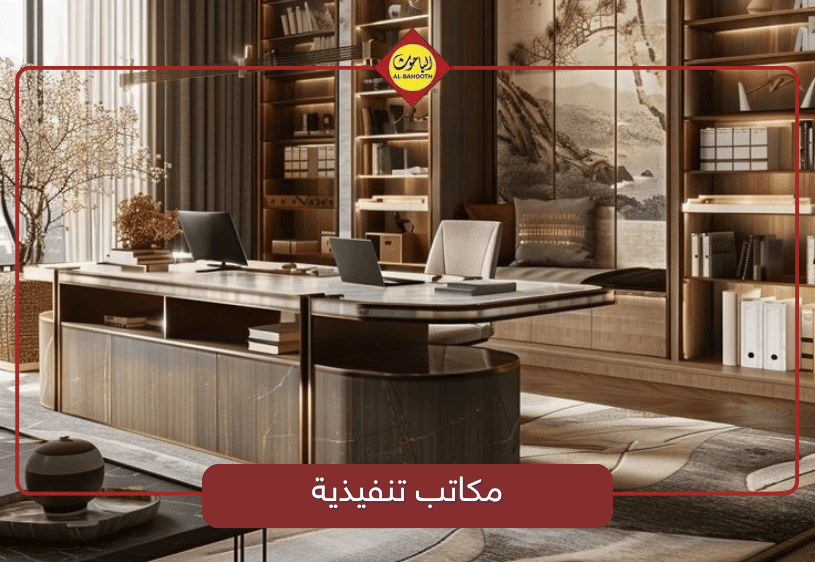
In the world of modern business, details make the difference between an ordinary office and a space that reflects a company's strength and identity. Executive offices today are much more than just a place to work; they represent an integrated environment combining meticulous luxury, high privacy, and advanced technologies that support productivity and highlight the standing of a leader or manager in the organization. Companies and business owners increasingly gravitate toward choosing executive offices as a key to leadership and influence, especially with the shift toward flexible work patterns and rising expectations regarding the well-being of leaders and decision-makers.
This article explores everything related to executive offices, focusing on their definition and distinctive characteristics among other office types.
What Are Executive Offices?
Executive offices are workspaces designed specifically for senior leaders and managers in organizations, such as chief executive officers and senior department heads. These offices stand out by combining luxury and functionality, granting their users an environment focused on high privacy, elegance, and advanced technologies. Such offices are frequently located in premium areas of a building, such as upper floors or quiet corners, overlooking expansive views with effective sound insulation, which enhances the concentration and productivity of their occupants.
How Do They Differ From Traditional Offices?
- Size: Executive offices feature spacious areas and are mostly housed in separate, closed rooms, whereas traditional offices are smaller and typically located in open environments or small rooms.
- Privacy: Executive offices provide high acoustic isolation and major privacy, allowing for a focused work environment, while traditional offices have limited privacy and often lack adequate sound insulation.
- Design and Furniture Quality: Executive offices feature luxurious furniture and sophisticated decor reflecting personal taste and functional standing, whereas traditional offices rely on functional furniture with mostly simple, uniform designs.
- Technical Equipment: Executive offices include multiple screens, advanced video conferencing systems, and smart office automation, whereas traditional offices contain only basic office equipment like computers and printers.
- Additional Facilities: Executive offices may incorporate a private bathroom, lounge corner, and small meeting areas, whereas traditional offices rely on shared and generally very limited facilities.
- User Demographics: Executive offices are designated for chief executive officers, general managers, and top-tier positions, whereas traditional offices are utilized by all employees across various administrative levels.
Executive offices clearly separate themselves from traditional offices through a higher level of comfort, privacy, space, and technical equipment, alongside a focus on highlighting the functional standing of their occupants and supporting them to perform tasks with maximum efficiency and calm.
What Are the Core Characteristics?
- Providing a supreme level of privacy and acoustic isolation to support concentration.
- Coming in spacious areas with closed rooms, mostly in premium locations within the building.
- Utilizing luxurious furniture and sophisticated or personalized decor reflecting elevated functional standing.
- Equipping these offices with the latest technologies, such as multiple display screens, smart control systems, and advanced conference tech.
- Typically incorporating built-in facilities like a private bathroom or lounge corner, alongside small meeting areas inside the office.
Executive office designs aim to combine functionality with a luxurious appearance, creating a distinct environment supporting the demands of leaders and first-row managers while enhancing their presence and providing the right atmosphere to handle sensitive and important business with high efficiency.
What Are the Advantages of Executive Offices?
The advantages of executive offices directly impact the productivity of leaders and managers, as furniture is carefully chosen to grant them comfort and support during long working hours. These offices rely on thoughtful lighting contributing to reduced visual fatigue and providing an ideal environment for concentration. They also leverage advanced tools and technologies that enhance collaboration ease and meeting organization without disruption. A quiet, distraction-free work environment effectively boosts strategic decision-making efficiency, while the nature of these spaces allows hosting sensitive meetings securely and confidentially. Data also shows that executive personnel in dedicated, equipped spaces achieve higher performance and feel greater loyalty toward their organizations due to the appreciation and independence they experience.
What Is Their Importance for Privacy?
Executive offices secure high levels of privacy by moving away from noise sources and offering a dedicated environment for handling sensitive documents, thus forming a safe haven for strategic plans and confidential discussions without worrying about information leaks or frequent disruptions.
What Is Their Role in Enhancing Professional Image?
Executive offices play a principal role in painting an advanced professional image of managers before clients and partners. This is vividly manifested through the luxury location and design of the space with all its lavish details, alongside highlighting corporate branding in a sophisticated manner. For instance, when an important visitor steps into a carefully designed executive office equipped with the latest technologies, they instantly sense the organization's seriousness and professionalism. These offices also allow hosting fateful meetings and prominent figures in ideal atmospheres, reinforcing a positive impression and reflecting professionalism in every detail.
Where Are Executive Offices Used?
- Major business corporations rely on executive offices to provide a suitable environment for executive managers when making sensitive decisions and holding leadership meetings.
- General administrative headquarters house these offices to support centralized tracking and policymaking activities in organizations.
- Law firms invest in executive offices to guarantee confidentiality when discussing cases with high-priority clients.
- Banks use them to manage meetings with distinguished clients or strategic partners within formal and secure atmospheres.
- Consulting firms adopt executive offices as a space for high-level meetings and strategy discussions with the management team or clients.
- Government institutions rely on them to hold closed meetings and follow up on sensitive files requiring a high degree of privacy.
In daily practical life, executive offices serve as a primary gathering point for carefully scheduled meetings requiring confidentiality and calm away from crowding. They are the optimal place for completing tasks demanding intense focus, such as drafting expansive development plans or evaluating internal team performance, while providing an ideal environment for receiving VIPs and official visitors in a manner reflecting organizational standing and attention to detail. Thus, executive offices occupy an important position in maximizing prestige and efficiency across competitive sectors.
What Are the Main Challenges in Executive Offices?
Executive offices are counted among the highest-cost options given their sophisticated equipment and high degrees of luxury. This cost noticeably rises in major cities or luxury towers, as location and exclusive advantages carry an additional weight on corporate budgets. This price variation generally depends on the service provider's nature or the geographic location of the executive office, and costs usually escalate if special services, high security levels, or unique facilities are involved.
Do They Affect Team Communication?
Physical isolation in executive offices may reduce direct and constructive communication opportunities with other teams inside the organization. These challenges clearly appear in instances where management needs fast or instantaneous interaction with employees, especially if the executive office is located on a separate floor or isolated area. In one example, some executives find difficulty grasping daily operation details or monitoring team dynamics closely, calling for innovative solutions to boost integration and guarantee effective communication between management and the rest of the team.
What Are the Challenges in Adapting to Flexibility?
Reshaping or modifying an executive office to meet greater flexibility needs in teamwork is often complex and costly, unlike what is possible in open-space systems or shared offices. This problem appears more prominently when rapid expansion or space reduction is required in fast-growing or changing companies.
What Are AL_Bahooth Furnishing Solutions for Executive Offices?
AL_Bahooth Furnishings offers an integrated suite of executive office products including corner and round desks with luxurious finishes and dimensions matching various spaces, alongside comfortable executive chairs specially designed to support long sessions. It also provides small meeting tables suitable for private meetings, upscale storage units facilitating file and supply organization, and contemporary lighting systems adding professionalism and visual comfort to the atmosphere. Materials range from imported products to locally manufactured items to suit every taste and need.
AL_Bahooth solutions achieve high levels of professionalism by integrating the latest technologies in its setups, such as smart conference systems, advanced environmental control, high-level security systems, and precise customer needs assessments. For instance, the office of one executive manager was designed and equipped to include advanced conferencing systems, hidden storage, and furniture blending aesthetics and practical functions, boosting daily work effectiveness and raising the level of luxury in the workspace.
AL_Bahooth also provides advanced design and customization services where customer requirements are studied, followed by consultative solutions and 3D designs prior to execution, while enabling the selection of materials and finishes to uniquely tailor each space in alignment with each client's identity, backed by long experience in the field and a focus on quality and innovation in after-sales services.
Frequently Asked Questions About Executive Offices
What are executive offices? Executive offices refer to spaces designated to support senior management in organizations and companies, acting as a center for organizing and managing human, financial, and logistical resources with the highest standards of professionalism and efficiency. According to official definitions, an executive office is known as an assisting administrative unit responsible for effective coordination across various work departments and providing a suitable environment for swift strategic decision-making.
Who is permitted to enter the executive office? Access to executive offices is mostly restricted to executive membership holders or senior managers in the organization. Certain policies also enforce specific age and organizational conditions for promotions or adding dependents, preserving the organizational and professional standing of the place.
What are the features of the executive office at the airport? The executive office at the airport provides an exceptional experience for managers and senior management members by offering the highest degrees of privacy and comfort. Beneficiaries can enter through private entrances far from crowding zones, benefiting from upscale hospitality and entertainment services alongside flexible transit and reception facilities, enhancing their schedule effectiveness and travel agendas.
Conclusion
Executive offices today have become a symbol of luxury, combining modernity, privacy, and productivity, imparting a professional touch to the work environment reflecting the leadership style of modern institutions and companies. This office type plays a pivotal role in shaping corporate image, boosting performance, and keeping pace with the demands of the era.