Motorized Curtains: Types and Pre-Installation Requirements
Explore motorized curtain types, power requirements, motors and control systems, along with the preparations required before manufacturing and installation.
Makaseb
November 18, 2026 at 6:45 pm AST
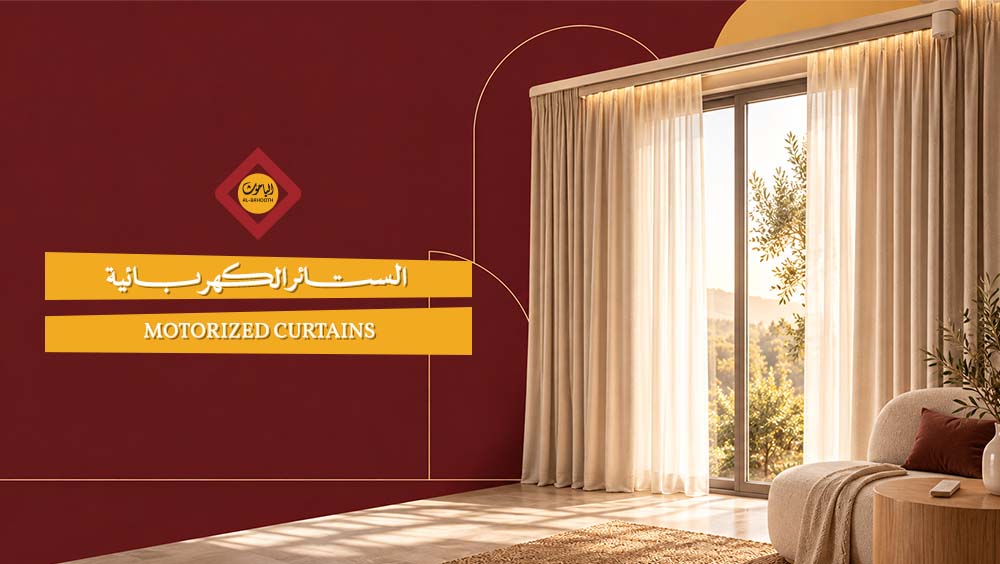
Many homes and offices require a practical way to operate high or large windows without relying on repetitive manual pulling. This is where electric curtains stand out—curtains driven by a motor rather than pulled by hand, with systems varying according to fabric movement, power source, and control method. Choosing the right type is not limited to fabric style or color; it extends to determining the curtain type, window measurements, and fabric movement clearance, alongside verifying the mounting position, electrical supply, and motor compatibility with curtain weight.
In the following lines, readers will discover the different types of motorized curtains, how to properly prepare motorized curtain setups, and what needs to be known before operating curtains inside any residential or commercial space. You can contact Bahooth Furniture Factory to discuss window and curtain requirements within your interior design and furnishing solutions, and request a price quote outlining the exact scope of work.
Electric Curtains and How They Work at Home
Electric curtains are driven by a motor following a mechanism suited to their shape and design, whether a sliding fabric curtain or a roller blind. The method of moving the fabric differs from one system to another, though the core concept remains the same: replacing manual effort with organized automated movement.
1. Components of a Curtain Drive System
In a sliding fabric curtain, the curtain motor operates with an overhead track or rail and a drive mechanism that moves the fabric to one side or opens it from the center according to system design. Conversely, in a roller blind, the motor wraps the fabric around a tube rather than moving it horizontally, which differs from the opening mechanism of sliding curtains.
Components of a curtain drive system typically include:
- The Motor: The component responsible for generating the motion that moves or rolls the fabric.
- Electric Track or Roller Tube: The rail along which fabric carriers glide in sliding curtains, or the tube around which fabric wraps in roller blinds.
- Drive Transmission Mechanism: The link connecting the motor to the track or tube to convert rotation into opening or closing movement.
- Control Unit: The element that receives commands and directs the motor to operate.
- Power Source: The electrical supply powering the motor and its associated unit.
The actual configuration of these components varies from one system to another based on curtain type and project requirements.
2. Difference Between Motorized Movement and Manual Pulling
Manual curtains rely on direct physical effort to pull fabric or rotate it via a chain or wand, whereas electric curtains rely on a motor handling this movement through a control unit. This differs from assuming every system supports smartphone operation or manual movement during a power outage, as those features depend on each individual system's design.
Types of Electric Curtains by Movement Style
The style of fabric movement serves as the primary classification point when selecting motorized curtains; a motor suited for a curtain gliding on a sliding track is not necessarily suitable for one wrapping around a tube, or for a slat-tilting mechanism. System selection ties directly to space design and project requirements, with the main systems categorized by movement below.
1. Sliding Track Fabric Curtains
These curtains rely on fabric moving horizontally along an overhead track fitted with a motor controlling opening and closing. Opening direction can be planned from one side or from the center depending on track design and space layout, while accounting for fabric stacking space at full opening within available room dimensions.
- Opening Direction: Determined during design whether movement occurs from one side or from the center toward both ends.
- Stacking Space: Adequate room must be left for fabric to gather when open without interfering with other room elements.
- The Track: Forms the mechanical foundation defining the fabric's travel path and compatibility with the selected motor.
2. Roller Tube Blinds
A roller blind moves vertically by rising and lowering around a winding tube rather than moving horizontally on a track. Motor suitability in this system varies based on blind dimensions and fabric weight, in addition to the specifications of the tube and motor used, linking component selection to each individual project.
3. Other Systems with Different Movement Mechanisms
Other systems utilize movement mechanisms distinct from tracks and rollers, such as tiltable slats, Roman shades, or cellular shades—each requiring a motor type tailored to its motion profile. System mechanics remain separate from fabric functionality regarding blackout or light filtering; the former describes movement style, while the latter describes material properties.
When executing furnishing projects, Bahooth Furniture Factory accounts for differences in electric curtains regarding tracks, rollers, and opening directions, specifying optimal standards for each space within project requirements.
Control Methods for Motorized Curtains
Control methods for electric curtains vary across systems, as this feature is tied to the chosen motor and receiver unit rather than being an automatic standard across all setups. Understanding these methods helps select the right system for project needs, whether for residential spaces or meeting rooms.
1. Remote Control and Wall Switch for Direct Operation
Some motorized curtain systems operate via a wireless remote enabling direct control without needing an internet connection, suiting spaces that do not require remote access or scheduling. Meanwhile, a wall switch provides a fixed on-site option, though availability depends on the motor and receiver unit used in each model.
2. Smartphone App and Smart Home Integration
Control via a mobile app or voice commands depends on the motor's compatibility with the adopted communication ecosystem, which may require an additional hub or bridge to activate this function. Smartphone or Wi-Fi support cannot be assumed simply because a curtain is described as electric, as this capability varies across systems.
- Compatibility: App control requires a motor compatible with a specific communication protocol.
- Bridge/Hub Unit: Smart home connectivity may require an intermediary device linking the motor to the home network.
- Voice Commands: Rely on linking the system to a smart home platform supported by the motor itself.
3. Control Features Requiring Advance Verification
Before adopting a specific control system for motorized curtains, verifying several key points is recommended to ensure compatibility with project needs:
- Setting Open and Close Limits: Confirming the ability to define start and end stopping points for curtain travel.
- Wall Switch or Central Control Support: Checking whether the motor allows linking multiple curtains to a single switch or central control panel.
- Connection Type: Determining whether the system operates via direct wireless signal or a home network.
- Need for an Intermediary Unit: Verifying whether adding a bridge device is necessary to enable app or voice control.
- Manual Override During Power Outages: Checking whether the model allows moving the curtain by hand if electricity goes out.
Steps to Prepare Windows Before Curtain Installation
Preparing a window to accommodate electric curtains goes beyond measuring the glass opening alone; travel path, fabric stacking allowance, and adjacent window space all impact the final installation plan. These steps involve gathering essential data prior to starting any execution work.
1. Measuring the Window and Surrounding Space
Curtain measurement begins by recording window width and height, alongside available space to the right, left, and top, as well as the proposed curtain placement relative to the ceiling or wall. There is no standardized numerical side extension that applies to every window, as this varies by room design and mounting style.
When preparing the window, it is preferable to record the following points:
- Window Width and Height: Accurate measurement of the actual glass opening.
- Side Clearance: Determining available space on the right and left to accommodate fabric travel.
- Top Clearance: Measuring the distance between the top of the window and the ceiling for track mounting.
- Curtain Placement: Deciding whether installation will be ceiling-mounted or wall-mounted.
2. Determining Opening Direction and Fabric Stacking
Curtain opening direction—whether one-way or center-split—ties directly to where fabric gathers when fully open. Selecting this direction requires considering nearby furniture, doors, or adjacent windows so fabric stacking does not obstruct daily movement within the space.
3. Inspecting Track Location and Movement Obstacles
Window preparation requires checking mounting surface levelness and anchor stability before installation, while identifying the surface material—whether concrete, gypsum, or wood.
Obstacles to watch out for include:
- Wall Protrusions: May limit track straightness or require repositioning.
- Window Handles: Can interfere with fabric movement during opening and closing.
- Air Conditioning Units: May require reconsidering mounting locations.
- Curtain Pelmet/Box: Requires verifying compatibility with surface type and mounting points.
4. Documenting Measurements for Every Window Before Ordering
Compiling window dimensions, opening directions, and proposed fabric types—alongside photos showing mounting spots—helps accurately discuss project requirements and identify on-site checks needed before finalizing the price quote.
Comparing Motorized and Manual Curtains for Home Use
Comparing motorized curtains with traditional curtains helps homeowners assess the value of adding motors to home windows before diving into measurement and preparation details. Key comparison points span daily control, overall appearance, and installation and maintenance requirements.
1. Daily Control and Window Access
Manual curtain operation relies on the user physically reaching the curtain to pull or close it, whereas electric curtains allow operating the fabric via a compatible controller without approaching the window.
- High Windows: Difficult to reach easily by hand, while an automated system simplifies operation from anywhere in the room.
- Large Windows: Manual curtains require long physical pulls, whereas a motor handles the entire travel effortlessly.
- Operational Convenience: Differences become clearly noticeable when opening and closing curtains repeatedly throughout the day.
2. Appearance and Space Distribution Around the Window
The type of track or roller tube and the fabric stacking zone when open influence both the final look of the window and surrounding space distribution.
- Fabric Stacking Area: Varies depending on the track type used, whether manual or motorized, and is best factored into decor coordination.
- Furniture Near the Window: Requires attention to curtain travel clearance so it does not clash with pieces placed nearby.
- Window Handles: Advisable to verify their positional compatibility with fabric movement in both options.
3. Installation and Maintenance Requirements for Each Option
Motorized curtains introduce additional decisions regarding power supply, control methods, and component compatibility, while accurate measurement and proper mounting remain shared essentials between both options.
- Power Supply: An automated system requires appropriate electrical preparation to power the motor.
- Component Compatibility: Requires ensuring harmony between the motor, track type, and chosen fabric.
- Measurement and Mounting: Remains fundamental whether choosing motorized or manual curtains to guarantee smooth operation.
When looking to evaluate which option best fits a specific home or project's needs, you can contact Bahooth Store, by Bahooth Furniture Company, to inquire about available solutions tailored to each space.
Frequently Asked Questions
The final answer depends on system and window specifications; below are direct answers to the most frequently asked questions.
1. Do electric curtains require Wi-Fi?
Some motorized systems operate via a direct remote control without needing internet access. App control or smart home integration depends on the motor's compatibility and may require adding a dedicated bridge unit.
2. Can electric curtains be installed on an existing window?
This depends on window measurements, track mounting location, fabric travel clearance, and available on-site power supply. Converting every existing manual curtain to motorized operation cannot be assumed successful without reviewing these factors.
3. Does the same motor suit all curtain weights?
Motor capacity and track limits are matched to fabric weight, dimensions, and layer count; therefore, a single motor is not chosen for all cases. The appropriate motor is selected according to each individual system's specifications.
4. What information is needed to request a price quote for electric curtains?
Window measurements, photos of the mounting location, opening direction, fabric type, control method, and available power source details are required. You can contact Bahooth Furniture Factory to discuss project requirements and accurately define the scope of work and suitable interior design.
Conclusion
Choosing the right electric curtains begins with identifying the curtain movement style suited to the window, followed by accurately measuring the window and fabric allowance, and then selecting the motor and control method aligned with usage needs. Next comes verifying mounting feasibility and available power supply, culminating in requesting a price quote clearly outlining specifications and installation scope. This sequential approach helps achieve an integrated solution mindful of space needs and functionality.
To equip homes or projects with electric curtains as part of a cohesive interior design vision, you can contact Bahooth Furniture Factory to discuss curtain requirements within home furnishing and interior design solutions. Sharing available measurements and photos helps initiate scope definition and accurately pinpoint the right specifications ahead of receiving a price quote tailored to your project.