Sofa Foam Density: How to Choose the Right Comfort Level
Understand sofa foam density and how it affects comfort, firmness and durability to choose the right option for your everyday seating needs.
Makaseb
October 15, 2026 at 12:28 pm AST
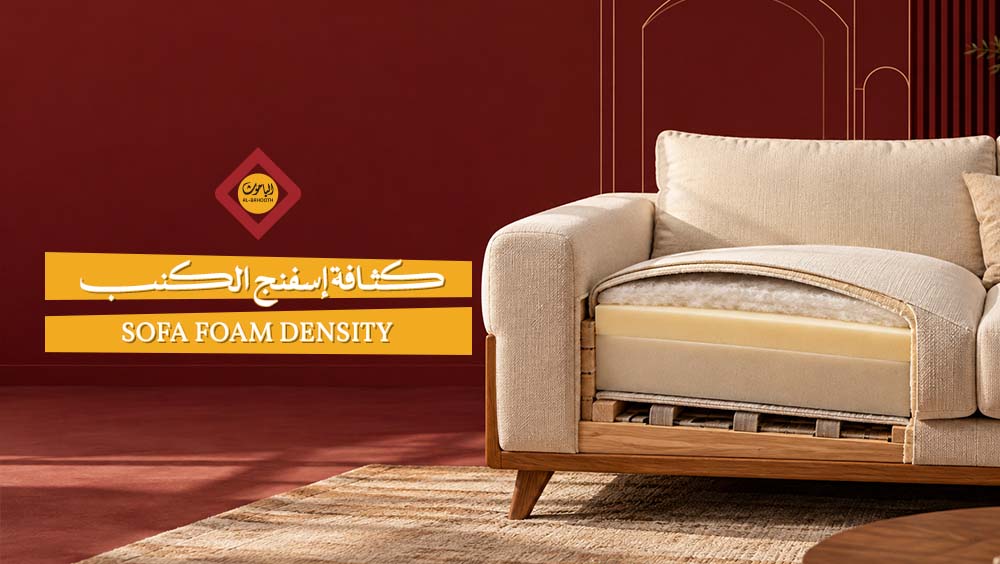
Sofa foam density does not mean seat hardness; rather, it describes the amount of foam material present within a specific volume. It is related to the cushion's ability to withstand repeated pressure from daily sitting and retain its shape over a longer period. As for the feeling of comfort, it is not determined by the density number alone, as other factors come into play, such as the firmness level and thickness of the cushion, the design of the seat, and the type of top layer that comes into contact with the body.
When considering choosing a new sofa or replacing old cushion padding, it becomes essential to strike a balance between foam density, firmness, and the intended place of use—whether it is a reception hall, a family living room, or a commercial reception space. Relying solely on the density number without considering these combined factors may lead to a result that does not meet actual needs regarding comfort or lifespan. AL-Bahooth Factory provides custom local manufacturing and made-to-order furniture solutions, and can be contacted to outline sofa project requirements or request a price quote suited to the space and intended usage.
What is the Meaning of Sofa Foam Density?
Sofa foam density is one of the essential specifications that determine the quality of sofa padding and its suitability for daily use. Understanding this concept helps in correctly reading padding specifications before selecting the appropriate furniture piece.
1. Definition of Density and Its Relationship to Foam Volume
Foam density is the mass of the material per unit volume, calculated by dividing the total mass by the volume it occupies. This number does not directly express the firmness of the piece, but rather the amount of material compressed within that same volume. For example, when sofa foam density is 30 kg/m³, this means that one cubic meter of this foam has a mass of about 30 kilograms. As this number increases, the amount of material within the same volume increases, which is reflected in the properties of the padding.
2. Units of Measurement for Foam Density
Two main units are used globally to describe sofa padding density, and understanding the difference between them is necessary when reading product specifications:
- Kilograms per cubic meter (kg/m³): The most common unit in local and regional specifications, used directly to describe sofa padding density.
- Pounds per cubic foot (lb/ft³): A unit common in specifications coming from other measurement systems, requiring conversion when compared to the metric unit.
- Converting 1.8 lb/ft³: Approximately equals 29 kg/m³.
- Converting 2.5 lb/ft³: Approximately equals 40 kg/m³.
- Converting 2.9 lb/ft³: Approximately equals 46 kg/m³.
It is worth noting that some product descriptions state only a number such as 30, 40, or 60 without clarifying the unit used. In this case, it is incorrect to interpret or compare the number to another before confirming the unit of measurement and the complete padding specification, because the same number may refer to two completely different values depending on the adopted unit.
What is the Difference Between Foam Density and Firmness?
Sofa foam density and firmness are two different characteristics, although confusion between them is common when choosing seats. Density describes the amount of foam material in a specific volume, while firmness describes the amount of force required to compress this foam to a certain degree. Understanding the difference between the two properties is essential for accurately evaluating seat feel.
1. Density as the Amount of Material in a Volume
Foam density refers to the weight of foam material present in a specific unit volume, usually measured in kilograms per cubic meter. This number expresses the amount of material used in manufacturing the piece, not how firm or soft it feels when sitting on it.
2. Firmness and Feel When Sitting
High-density foam can feel soft when sat on, and low-density foam can feel hard upon initial pressure. Therefore, the term "high density" alone is not sufficient to prove that a seat is hard or comfortable. The degree of hardness or softness is determined by factors related to the composition of the foam itself, not just the amount of material in it. It is preferable to use the terms firmness, softness, and seat feel separately from the term density when describing any piece of furniture, to avoid confusing two relatively independent properties.
3. Significance of ILD and IFD Indicators
The ILD or IFD indicators express the force required to compress a foam sample by a specific percentage, and they are tools for measuring the degree of hardness more accurately than the density number alone. The measurement method may depend on compressing the sample by 25%, but it is recommended to refer to the manufacturer's approved test method to know the exact basis of the declared value.
- ILD/IFD Index: Expresses the force required to compress the foam sample by a specified percentage, where a higher value usually means a firmer feel when sitting.
- Density Number: Such as 35, should not be equated with the level of firmness, nor should comfort level be inferred from it alone.
- Separation of Terminology: It is preferred to use terms of firmness, softness, and seat feel independently of the density term when evaluating any piece.
What is the Appropriate Density for Daily Sofa Seats?
Sofa seats used daily require padding capable of regaining its shape after repeated sitting, and the appropriate sofa foam density varies depending on the usage pattern and design type. Available technical guides present indicative ranges that help estimate suitable padding without considering them a fixed standard.
1. Indicative Ranges for Regularly Used Seats
Some technical sources point to a rough starting point around 29 kg/m³ for general indoor seating, with a broader range between 29 and 40 kg/m³ for regularly used seating.
- Basic Range: Lies between 29 and 40 kg/m³ and is presented as a starting point for regular-use seats.
- Higher Durability Range: Extends from 40 to 46 kg/m³ for daily seats intended to withstand longer use.
- Important Note: These figures are indicative ranges and not a binding standard for every market or foam type, as results vary according to different manufacturing and design factors.
2. Factors That Alter Density Suitability
Relying on the density number alone is not enough when evaluating suitable seat padding, as a set of factors interact to determine the padding's suitability for daily use.
- Foam Composition and Type: Padding performance varies across different foam types and firmness levels, even at similar densities.
- Padding Thickness and Sofa Design: Seat thickness, padding distribution, and the structure of the seat itself affect the final result.
- Frequency of Use and User Weight: Padding performance is linked to sitting frequency, user weight, and duration of sitting.
- Installation Method: The result varies based on how the padding is fixed within the seat frame and supporting structure.
- Insufficient Commercial Numbers for Comparison: Some factories use labels like 30, 33, 35, 40, or 60, designations like N or HR, or marketing descriptions like "Super", without clear standardization in specifying the unit, foam type, and firmness. Therefore, these numbers alone are unsuitable for comparing products unless these details are mentioned together.
Choosing the appropriate foam density range for daily-use seats requires considering all these factors together, rather than looking at a single number isolated from its context.
Variation of Seat, Backrest, and Armrest Padding
A single padding type does not serve the same purpose across all parts of a sofa; seat cushions endure repeated pressure from sitting, whereas the support patterns for the back and armrests are completely different. It is appropriate to evaluate each part's specification according to its function, rather than assuming seat padding works for all parts of the piece.
1. Requirements for Sofa Seat Padding
Sofa seat cushions require padding capable of enduring daily pressure from repeated sitting and rising without quickly losing shape. When requesting custom manufacturing or replacement for this part, it is recommended to clarify several key elements:
- Density and its Unit: Determines foam cohesion and resistance to compression over continuous use.
- Firmness: Reflects the level of support felt when sitting according to personal preference.
- Thickness: Impacts height and overall comfort feel.
- Foam Type: Determines the response nature and long-term stability of the seat.
2. Differences Between Backrest/Armrest Padding and Seat Padding
Backrest foam differs from seat cushion padding in how it experiences pressure, as the back undergoes lateral and continuous support during leaning rather than direct, repeated downward pressure. Therefore, specifications for this part should be considered separately without applying fixed numbers across all pieces.
As for armrest padding, it is subjected to lighter, less frequent pressure, often involving partial or temporary leaning. Setting its specifications requires considering density, firmness, thickness, and its specific foam type in line with the design and function of the piece, without relying on seat cushion specifications as a general reference.
3. Combining a Supportive Layer with a Softer Layer
A seat design may combine a more supportive base layer with a softer top layer to achieve a balance between stability and a comfortable seating feel. The suitability of this construction depends on the piece's design and user preference. The structure also differs depending on whether the padding is a single continuous piece or separate cushions, which affects measurements, replacement methods, and finishing. Assuming a single design for all sofa types is impractical, as cushion thickness and layer distribution vary according to the purpose of the piece and its daily use.
Foam Types and Degrees of Use
Upholstery foam types vary depending on the amount of material per unit volume and the associated elasticity characteristics, which directly impacts sofa foam density and behavior under repeated use. Understanding these differences helps in reading specifications accurately before choosing any type.
1. Low-Density Foam
Low-density foam contains a smaller amount of raw material compared to the same volume in other types. This type may lose its original shape faster when exposed to repeated pressure, depending on its composition and target use.
- Initial Firmness: Low-density foam may feel firm during the first seating pressure, but this does not necessarily mean it is uncomfortable.
- Changes Over Time: Shape degradation links more to usage amount and construction quality than to initial seat feel.
2. High-Density Foam
High-density foam usually contains a larger amount of material in the same volume, which often provides higher resistance to degradation over extended use.
- Does Not Mean Hardness: Higher density does not necessarily make the foam hard, as texture depends on factors other than material quantity alone.
- Not a Guarantee of Performance: High density alone does not determine final performance level without considering the rest of the foam specifications.
3. HR Foam and Commercial Descriptions
HR foam refers to a description of foam type or elasticity properties, and is neither synonymous with density level nor a measure of firmness itself. Confusing this description with sofa foam density or firmness can lead to an inaccurate reading of specifications.
- Terms like "soft foam", "super", or "high pressure" may not reflect actual density or firmness on their own.
- Requesting written numerical specifications with the unit and foam type—whether HR foam or other upholstery foam types—is recommended.
- Stating the unit and foam type together helps compare options with greater accuracy instead of relying solely on trade names.
To view custom specifications for sofas and furnishings, AL-Bahooth Factory can be contacted, where project requirements are defined and price quotes provided according to need.
Frequently Asked Questions
What is the appropriate density for sectional sofa foam?
The appropriate sofa foam density for sectional sofas varies according to usage rate and desired seating feel. Approximate ranges serve as a general reference point without generalizing across every design:
- Moderate Use: Starts around 29 to 40 kg/m³ as a general baseline.
- Intensive Daily Use: May require around 40 to 46 kg/m³ for higher endurance.
- Influencing Factors: Foam type, firmness, thickness, and piece design, making selection vary from one sectional to another.
What is the pressure level of sofa foam?
Sofa foam pressure differs from density; pressure or firmness is often expressed through indicators like ILD or IFD according to a specific testing method defined by the manufacturer. There is no single standardized pressure number that applies to all foam types without referring to clear written specifications. Therefore, requesting this value in writing is preferred over relying on general estimation.
What is the price of a density 40 foam sheet?
A fixed price for a density 40 foam sheet cannot be determined without knowing additional details, as pricing requires knowing the density unit, sheet dimensions, thickness, foam type, and target market. For custom sofa requests, AL-Bahooth Factory can be contacted to explain specifications and receive a suitable price quote based on project requirements.
How do I know the foam density?
Foam density is identified by requesting the written value in kg/m³ or lb/ft³ directly from the supplier or manufacturer. It can also be calculated for a sample with known dimensions by dividing its mass by its volume while accurately aligning measurement units.
- Relying on color or foam texture alone is insufficient to determine density.
- Descriptors like "super" do not individually indicate a specific density value.
- Referring to written specifications remains the most accurate way to know density.
Conclusion
Choosing the right sofa foam density depends on evaluating several combined factors rather than relying on an isolated number. Documented density with its unit, paired with firmness matching the desired seating feel, alongside suitable thickness and design for the sofa seat, form the elements that determine comfort and durability together. Density numbers alone do not determine comfort level nor explain all instances of sagging that may appear in sofa padding over time. Evaluating foam specifications requires reviewing firmness and design alongside density to select the best option for each application.
AL-Bahooth Factory offers local manufacturing and custom-made furniture, and can be contacted to explain sofa or furnishing project requirements and request a price quote suited to the nature of the required project.